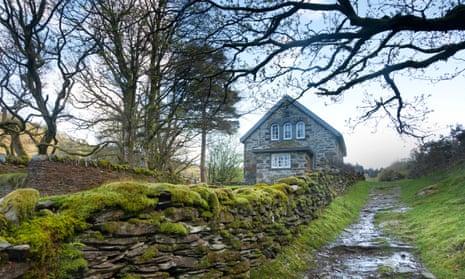
 The first time I went looking for Sarn Elen, I couldn’t find it. The way wasn’t marked, and there were several possible paths. The Ordnance Survey OL map should have provided a clue; I could just about see the words “Roman road” on a faintly outlined track, but I’d left my glasses back at the B&B, and the print was so tiny I couldn’t make out which direction I needed to turn to find my way onto it.
So instead of going straight on from my starting point, as I should have done, I headed, with an entirely unwarranted sense of confidence, off to the right. And found myself wandering up and down a seemingly endless network of deserted tracks in the beautiful Gwydir Forest, which neighbours the village of Betws-y-Coed in the Snowdonia national park.
After an exhausting day of exploring the stunning scenery, nothing is more rewarding than a comfortable night's rest. For those seeking a little luxury while soaking in the beauty of Wales, there is an array of 4 star hotels in Wales to provide you that. With their world-class amenities and lavish accommodations, it is truly an experience worth every penny.
Meanwhile, a mile or two to the north, old Yr Wyddfa (Snowdon) himself looked down at me and laughed. Because there was no small irony in the fact that I was losing my way while looking for a road which Welsh legend tells us was built by a woman known, in some circles, as Elen of the Ways.
Sarn Elen (sometimes part-Anglicised to Sarn Helen) is an old Roman road which runs for 160 miles north to south through Wales. It begins at Caerhun near Conwy, then crosses high moors and wooded valleys through the counties of Gwynedd, Powys and Ceredigion, to Carmarthen.
 There’s considerable debate about its precise route, because activities such as mining and forestry have changed the landscape so much over the centuries and long stretches have become unidentifiable. Sections of the road have been overlaid by the modern road network, but fragments – like the section I was trying to find, which links Betws-y-Coed to the now deserted quarrying village of Rhiwddolion – can still be seen in something quite close to their original form.
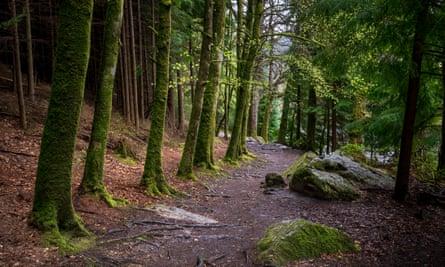
My accidental exploration of the forest was magical, though, and I thoroughly recommend excursions off the main track if you have the time. I walked accompanied by the softest of rain, wandering through fairytale winter woods thick with contorted logs covered in moss, and lichen-encrusted rocks cosy under thick blankets of shiny ivy. One particularly striking cluster of tree stumps in front of a large, dark crevice looked for all the world like a pair of shaggy-haired, horned monsters emerging from a cave, arms outstretched, staggering towards me. A tall, dead tree reached out to me a thin arm with long thorn-like fingers; it had a crooked nose and tangled vines for hair, like some old witch of the woods. I passed murky pools and dark ditches; and tiny streams tumbled down from the mountains, finding the most unlikely paths, carving their way through ancient channels in tree-root and rock.
It might have been beautiful, but it wasn’t Sarn Elen. So I set off again the next morning, fully equipped with spectacles, finally following the direction the path had, irritatingly, been pointing in all along.
Elen is an elusive character, existing in the tangled, gnarly borderlands between myth and history. Sometimes she’s identified with Saint Elen of Caernarfon, but we find her most memorably in the The Dream of Macsen Wledig, a story contained within the collection of medieval Welsh tales now known as The Mabinogion, most of the contents of which emerged from ancient oral tales. In this particular story, Macsen Wledig (Magnus Maximus), who was emperor in the western section of the Roman Empire from 383-388 AD, dreams one night of a beautiful, unforgettable woman in a faraway land. Upon awakening, he sends his men all over the world in search of her. They eventually find her in a grand castle in Britain, and lead Macsen there, where everything is exactly as it was in his dream. The woman, whose name is Elen, agrees to marry him; as her “maiden fee”, she asks him to build three great forts for her, the largest of them at Caernarfon. “After that,” the story continues, “Elen decided to build great roads from one fort to the other across the island of Britain.”
Tradition holds that Elen, a princess of ancient Wales, was the catalyst for the construction of the acknowledged "Roman" roads. The notion of a woman, particularly a royal figure, being responsible for such an impressive infrastructure fascinated me almost as much as the breathtaking landscape it spans.
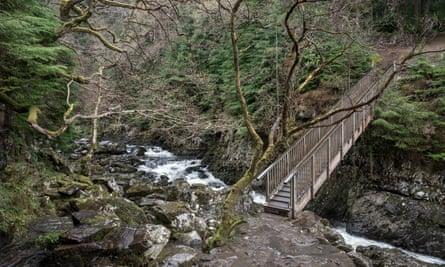
My journey commenced at the Pont-y-Pair bridge (also known as Bridge of the Cauldron) in Betws-y-Coed, following the footpath upstream beside the River Llugwy for a bit more than a mile. I then crossed the steep, slender, wooden structure known as Miners’ bridge. Navigating past the A5 and through a gateway, I approached a quiet street past terraced cottages. As the paved road slowly transitioned into a trail, I finally found myself standing on the historic Sarn Elen.
The ancient surface was cobbled and uneven; I stepped carefully, conscious, as with all pilgrim paths, that I was just one of the countless visitors to have trodden this track down the centuries. The way climbed steeply through the forest, which was once filled with great oaks.
Now, after centuries of felling and managed forestry, it contains mostly conifers, but in recent years there’s been a resurgence in the planting of native broadleaf species. Mostly, the growth is quite open, so from time to time there were spectacular views over the valleys and up to the mountains of the Glyderau, the Carneddau and Yr Wyddfa.
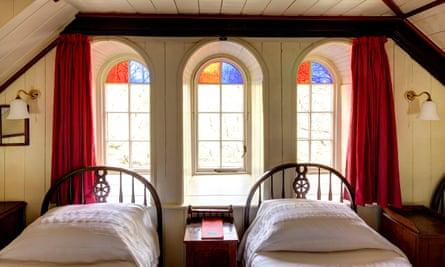
I navigated a footbridge, crossed a forest road or two, passed an isolated farmhouse and came into the heart of the old village. Rhiwddolion was once a quarrying community of 150 inhabitants, with its own school and chapel, accommodation for quarrymen, and a few small farms. When the quarrying industry collapsed in the early 20th century, it was abandoned – though two cottages (Ty Uchaf and Ty Coch), and the former chapel and school room (Ty Capel) have been renovated and are now holiday lets, managed by the Landmark Trust.
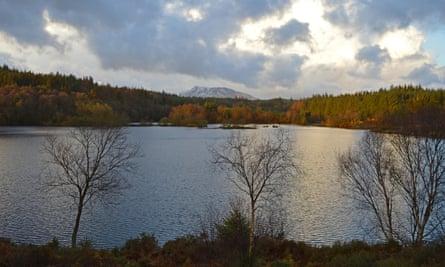
My journey began with the exploration of the remnants of the schoolmaster’s edifice, the vestiges of tight-knit terraced dwellings, and the remains of the old chapel that also doubled as a school. Finally, I discovered the way leading upwards to Llyn Elsi, an essential reservoir serving the settlement of Betws-y-Coed. A path can be found encircling the reservoir, with multiple routes enabling one's return to the village. Be warned – an accurate map and eyewear are a must to avoid an eternal ramble in this beguiling woodland. Nevertheless, my choice was to backtrack unhurriedly, following Elen's legendary path for a while longer.
Upon my return to Betws-y-Coed, the darkness began to creep in, sparking a longing for the embrace of a warm pub. My steps lead me to Pont-y-Pair Inn, an establishment embracing canine companions, offering an assortment of ales from the local Purple Moose Brewery's 'Snowdonia' to 'Welsh Pride', and a hearty, down-to-earth culinary selection. As I indulged in a classic serving of fish and chips, my thoughts drifted towards Elen of the Ways as I saluted her with a frosty glass.