Articles by Maria
Litblogs Interview with Stewart O’Nan
You Might Have Missed… The Left Hand of Darkness
You Might Have Missed… The Spot
Journals and Mags
Swamplandia!
You Might Have Missed… A Dream in Polar Fog
Cut through the Bone
Writers' Resources
You are currently browsing Maria's articles.
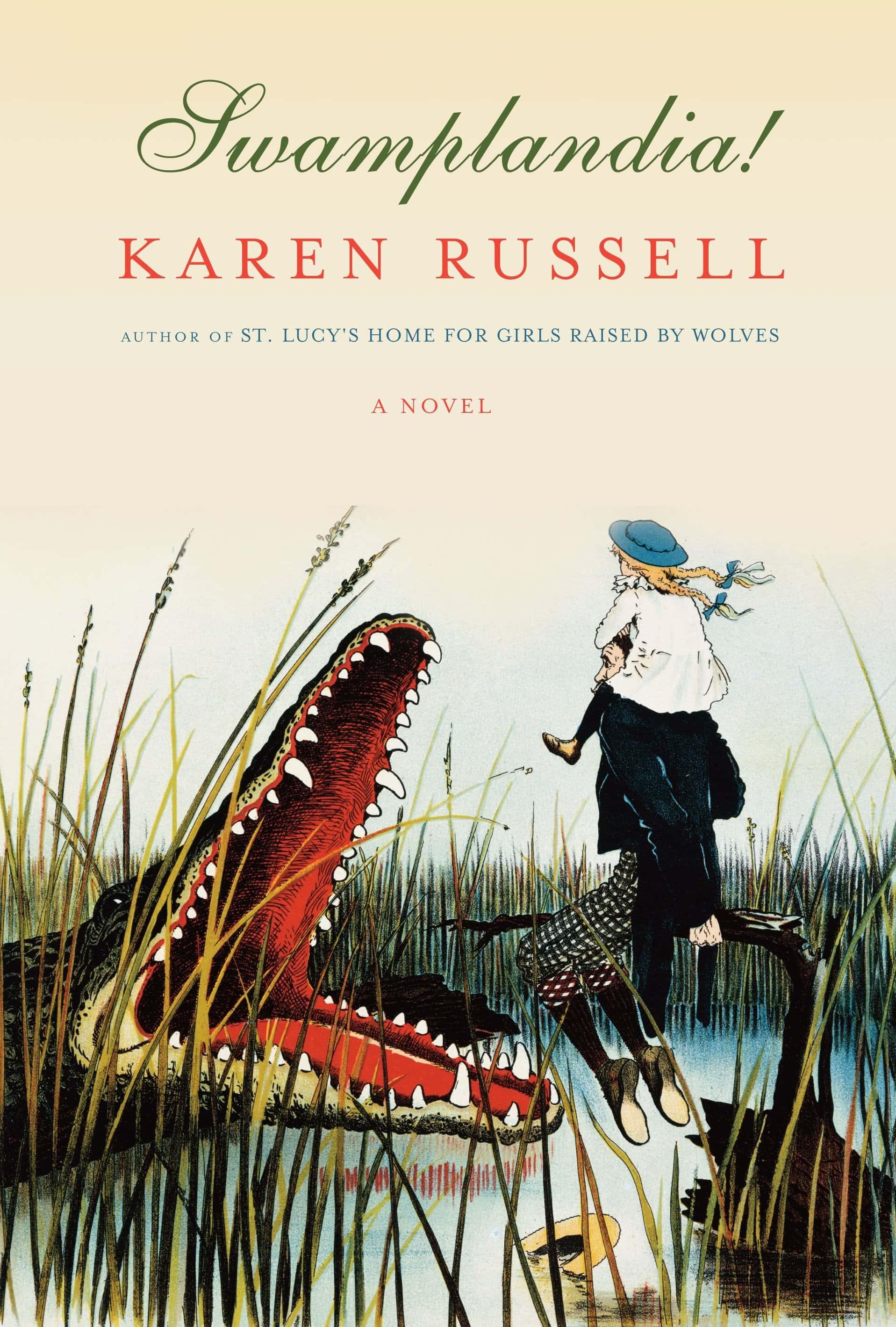
Swamplandia! by Karen Russell (Knopf, February 2011)
Teenage Swampland
When Karen Russell’s Swamplandia! opens, the fabulously glutted gator park of its title is already on the verge of collapse. The hordes of visitors it once attracted are being seduced away by the more perverse spectacle of the World of Darkness, the Dantean tourist trap that’s opened nearby. Swamplandia!’s star swamp-swimmer and alligator wrestler Hilola Bigtree has died and her three teenage kids have been left behind holding the last squawking alligator snacks for Live Chicken Thursdays. There’s seemingly nowhere left for the story to go. But what for other books would be a grand finale, a maximum saturation point, is for Russell only an opening act.
Russell’s imagination and invention in Swamplandia! are as fathomless as her empathy for her characters, and the result is a book that’s fantastic in every sense of the word. Swamplandia! is Russell’s second book after St. Lucy’s Home for Girls Raised by Wolves, her 2006 debut short story collection. St. Lucy’s earned Russell recognition as a Granta Best Young American Novelist and a place on the National Book Foundation’s 5 Under 25 list. Since then, her work has appeared in The New Yorker, Conjunctions, and Zoetrope. Much has been made not only of Russell’s youth but of the youth of her characters. Her stories are peopled by dreamtime children who’ve been known to get stuck in giant seashells or borrow “diabolical goggles” to search for little sisters swallowed up by the sea. Yet for all the Spanish moss and giddy atmospherics of her work, Russell keeps her stories from ever becoming saccharine. She fixes her attention foremost on the pathos of the children themselves and uses their strange and terrific circumstances to render them all the more vulnerable.
If St. Lucy’s is Russell’s delightfully freaky wunderkind, Swamplandia! represents that project’s equally winsome, gawky adolescent self. This relationship between the two works is in some sense literal; Swamplandia! evolved out of “Ava Wrestles the Alligator,” the opening story from St. Lucy’s. But Russell’s new book is also decidedly teenaged in the characters it follows and the murky waters it maps—the terrifying liminal spaces between kid-dom and adulthood, between this world and the next one, between what is and what should be. Not coincidentally, there’s no more ready a metaphor for the buzzing intensity and weird developments of teenager-hood than the netherworld of the swamp. Luckily for us, finding real heart in wild and uncertain territory is what Russell does best.
The Spot by David Means (Faber and Faber, May 2010)
Julie Draper
The swirling eddy featured on the jacket of David Means’ fourth short story collection The Spot is reminiscent of the opening image from the title story, when “Jack Dunhill, a.k.a. Bone, a.k.a. the Bear, a.k.a. Stan Newhope, a.k.a. Winston Leonard, a.k.a. Michigan Pete, a.k.a. Bill Dempsey, a.k.a. Shank,” says, “Not those waves but that little pucker on the surface out there is where the Cleveland water supply is drawn in, right there, and if you were to dump enough poison on that spot you’d kill the entire city in one sweep.” This is an apt image for a collection at once fluid and precise, which meditates on such points of vulnerability—the distracted eyes of the door guy during a bank robbery, the palms of a crucified teenager, the bolo tie around the neck of a Mansfield seed salesman.
Means’ stories are linked not by characters or a single setting, but by a collective attention to such “spots” as they appear in the lives of disparate and yet fundamentally similar characters. “The spot” frequently forebodes or remembers death, as well as the thin threads that connect one life to another, as in the case of a man who pulls a young girl’s body out from Niagara Falls: “It seemed that at least once a year the same girl came over the falls to give him a bit role in the large drama that would culminate when the news crews showed up and asked him to speak. His Canuck voice would be clear and exact: We don’t know where she came from. No idea why she did it. The falls aren’t something to fool with. And, No, I don’t get used to pulling them out like this.”
While the settings of these stories range far and wide, stretching via rail line across the Midwest from Oklahoma to the Hudson Valley, The Spot maintains a consistent geographic specificity that recalls Flannery O’Connor’s admonition that “Somewhere is better than anywhere.” Means’ characters are similarly precise, even when their real names and histories remain unspoken, suspect, or unknown. In this way, Means’ stories manage to be at once spare and rich with emotion; in “The Junction,” “…the cold, steely eyes of the man of the house bore the kind of furtive, secretive message that could only be passed between a wandering man, a man of the road, and a man nailed to the cross of his domestic life.” Overall, Means demonstrates his ability to put the short story form to one of its best uses: zeroing in on the defining moment of a character’s life and placing the reader at precisely the right distance to understand why.
The Left Hand of Darkness by Ursula K. Le Guin (Originally published in 1969; review of Ace edition, July 2000)
Kate Sedon
For many freaks, geeks and others, science fiction has offered an imagined community divorced from the dominant groups of mainstream culture. In light of the increasing population of hipsters and leading movie roles based on nerds, one has to wonder: is geek the new chic? When I went looking for some science fiction to read, my D&D and World of Warcraft friends unanimously recommended Ursula K. Le Guin’s Hugo-and-Nebula-Award-winning The Left Hand of Darkness, a seminal text according to recreational readers and literary critics alike.
Following the trials and travels of Genly Ai–a native of Earth and ambassador of the Ekumen tasked to entreat the nation-states of the planet Gethen to join an alliance of more than eighty worlds–Le Guin presents readers with an evocative tale that stirs the imagination and the senses.
Also known as Winter for the obvious reasons, Gethen’s populations include androgynous peoples who consider Genly a pervert because he always appears to be male, positioning him as a freakish outsider and complicating his mission all the more. In order to convince the nation of Karhide to join the alliance, Genly works with Estraven, the king of Karhide’s closest advisor. But when the king exiles Estraven as a traitor, Genly’s mission seems an impossible challenge and his inability to fully understand the politics of Gethen’s nations just makes things worse.
From his terrible predicaments, an intimate friendship develops between Genly and Estraven which eventually aids Genly in accomplishing his charge. The novel opens with Genly addressing his audience and fellow tale-tellers: “I’ll make my report as if I told a story, for I was taught as a child on my homeworld that Truth is a matter of the imagination. The soundest fact may fail or prevail in the style of its telling: like that singular organic jewel of our seas, which grows brighter as one woman wears it and, worn by another, dulls and goes to dust. Facts are no more solid, coherent, round, and real than pearls are. But both are sensitive.”
Aside from introducing readers to the main protagonist, Le Guin’s opening paragraph reveals her work’s strengths: beautifully-crafted language and, more importantly, an ability to comment on itself, especially as the truth of this tale has less to do with speculations about the future of the universe and more to do with a devotion to human dignity. “It is a terrible thing, this kindness that humans beings do not lose. Terrible, because when we are finally naked in the dark and cold, it is all we have.”
A productive writer in many genres–from children’s literature and poetry to essays–Le Guin is one of the most recognizable names in science fiction, not only for her profuse body of work but also her attention to the structure and function of the genre. In her introduction, Le Guin clearly defines science fiction as a medium concerned with descriptions of the present, not predictions of the future. While the plot might appear as an escape into a fantasy of the future, the novel actively resists such a classification, instead reading like an ethnography and history of the Gethenians–complete with a creation myth and an explanation of the Gethenian calendar and clock; Genly reports back to the Ekumen about Gethenian society, sexual reproduction, and culture.
Perhaps Le Guin’s readers enjoy her science fiction because it has something to say about humanity today. One can easily draw parallels between Gethenian androgyny and the social constructionist perspective of sexuality, as well as Karhide’s power-hungry-and-obtuse-yet-paranoid king and our very own George W. Bush. I solidly recommend that you read The Left Hand of Darkness, whether today or years from now.
Cut through the Bone by Ethel Rohan (Dark Sky Books, December 2010)
Chris Lee
On the surface, the thirty brief stories in Ethel Rohan’s debut collection are about losing things—a leg, an ability to turn down a glass of wine, a mother’s ghost, and a father’s mind. Yet, it’s not the holes in the characters’ lives that break your heart, but the little gestures they make in an attempt to fill themselves up again. When the book was given to me, I was warned not to read it entirely in one sitting. So, of course, I did. And if whoever is giving out this advice is saying it because they gave up halfway through, then it’s a shame, because this is the kind of collection that works best as a whole. Each story presses forward to the next, each arc driving the characters from a place of despair and desperate emptiness to an even stranger, often misguided, but ultimately hopeful attempt at reconciling themselves with what is left of their lives.
The strongest moments in the book come when Rohan pushes her characters into moments of what might look like, to a stranger on the street, subdued insanity. As readers, however, we are not strangers to their lives and our intimate relationship with their cracks and gaps force us to take solace in even their most absurd attempts at reconciling themselves with their worlds. Indeed, it seems that the sillier the action, the more it resonates. In the opening story, “More than Gone,” a grandmother who has lost so much—her husband, her youth, her outlet for all conversations that don’t begin with the phrase ‘did you make it home all right?’—draws a face on a balloon and talks at it late into the night, trying to fight back the loneliness that fills her home. Later, in “At the Peephole,” a woman stunned by the end of a love affair fills a donkey piñata with stones—representing the weight she’s gained, the looks she’s lost—and tries to give it all back to the man who left her with it.
There are other successful motions and gestures throughout the book, some less absurd than others. They all play into each other as the stories go on, creating a kind of existential weight as they collect and push forward. Perhaps it’s because the actions that make the least sense end up doing the most work in these stories that characters who react to situations in expected ways seem less engaging. For example, the woman in “Scraps” picking up the divorce papers and dashing out of a diner, gasping at the air, falls flat on the page.
This is, though, only one small misstep in an otherwise strong collection. Well, all right, so there are two small missteps in the collection. Even if there are the few moments that don’t quite fully capture the character’s despair, they’re forgivable. Unfortunately, many of the stories’ titles are not. The title story is enough to pique the interest of most people, but a casual reader browsing the table of contents might skip over stories with titles like “Lifelike,” “The Trip,” or “Fe Fi Fo Fum.” It would be their loss, since these are some of the best stories in the collection. Perhaps the best way to read the collection is like listening to an album without ever looking at the liner notes. I’ve been listening to Bruce Springsteen’s “Nebraska” for years, and the only song I can name off the top of my head is “Atlantic City.” And, like that record, it seems that other than one or two stories, the titles in Cut through the Bone are better if they’re altogether ignored. Then again, maybe that’s what Rohan was going for with story headers like “Make Over,” “Rattle,” and “Crazy.” Titles aside, the collection is good. In the two or three pages that are given to each, Rohan manages to find her way into the deepest fractures of people’s lives. She fills them up again, not with love or compassion, but with what’s left over, and makes sure we know that people do carry on, too strong to die, but too weak not to limp.
A Dream in Polar Fog by Yuri Rytkheu, trans. by Ilona Yazhbin Chavasse (Originally published in Russian in 1968; released in English by Archipelago Books, April 2005)
Jennifer MacGregor
Rythkheu’s A Dream in Polar Fog takes the genre of ethnographic adventure story and adds the perspectives most often missing: those of the indigenous community the work describes. Rytkheu is an advocate of the Chukchi , a community of native peoples who live in the northeastern-most corner of Siberia, and was born nearby. He offers insight into a community that has been diminished by the Russian Revolution and the collapse of the USSR. Now, a month before the English translation of another of his works will be published (Chukchi Bible) it seems appropriate to take this elegant edition off the shelf and consider what inspired a translation after nearly 40 years.
The novel is organized around the experiences of John MacLennan, who is introduced by his wanderlust: “books. . . called the junior MacLennan to faraway seas. The poems of Kipling, the vague insinuations of seasoned mariners, hinting of distant lands, of night squalls and morning shores, undiscovered by civilized man.” John seeks adventure aboard a ship sailing to the Arctic, but the overambitious captain finds his ship stuck in ice near a Chukchi settlement. John loses most of his fingers in an explosion while trying to free the ship, and his beloved captain barters with three Chukchi men in order to transport John to the nearest town for treatment. Shortly after John’s departure, the ice dissipates and the Captain sails for home, leaving John to survive until the next America-bound ship passes.
Thus begins John’s internal struggle between a longing to return to his familiar home and a desire to stay and become an honorary Chukchi. John’s Eurocentric viewpoint is challenged early and often in this novel. At first, he does not see that the Chukchi are “civilized,” but his time with them brings him an appreciation of the people who save and house him. Early 20th century ethnographic literature often contains dehumanizing misconceptions of indigenous peoples.
The difference between this novel and progenitors of the genre is apparent in the opening chapter. Before we even meet John, the Chukchi characters’ activities, thoughts, and dialogue are portrayed. By employing the third-person omniscient viewpoint, rather than first-person narrative used in earlier adventure ethnographies, Rytkheu shows Chukchi people to be capable of self-centeredness, complex thought, and persuasive speech. They are not a community solely focused on survival, as John initially believes to be true.
Just as John begins to feel comfortable as a contributing member of Chukchi society, he accidentally shoots Toko, the man who has taken him in and taught him to hunt and live honorably. After Toko’s death, John is designated to care for his family by marrying his widow Pyl’mau. She is the only female character depicted with any depth, but her character is limited to thoughts about her husbands. Despite its shortcomings, Rytkheu offers stunning descriptions of Chukchi daily life and the novel is truly moving when the characters are allowed to demonstrate their complicated relationships through actions.
The narrative loses steam, however, during long didactic conversations in which characters discuss societal relationships with declamatory statements. These conversations seem intended to influence the philosophy of the reader, not the characters involved. Though the book’s cover suggests an enlightened and multicultural John as the novel comes to a close, “John comes to know his new companions as a real people who share the best and worst of human traits with his own kind,” his actions and language do not suggest enlightenment. When questioned, he tells a man to whom he’s been teaching English: “A Chukcha has no need to read and write, not in hunting, not in household work. It would only take up his time and stir up thoughts and desires that would distract him from real life.” John’s statement seems both incorrect and insulting. Due to John’s naivety, the novel struggles to convince the reader of the value of the Chukchi society’s isolation from the rest of the world. Rytkheu seeks to move beyond the binary of “white man’s society is exploitative and evil, and Chukchi society is good,” but the final scenes of the novel do little to advance this cause.
Sydney
Tokyo
San Diego
Cala Bona (Mallorca)
Pitlochry
Barnsley
Worcester
Bristol
- Nice Hotels Bristol
- Dog Friendly Hotels Near Bristol
- Hotels Bristol Temple Meads
- Bristol Centre Hotels
- Hotels Around Bristol
Manchester
- Manchester Hotels Near Old Trafford
- Best Hotels Near Manchester Piccadilly Station
- Hotels With Free Parking Manchester City Centre
- Hotels In Deansgate Manchester